Hera begins close survey of the asteroid NASA struck in 2022
The European spacecraft is studying Didymos and its moonlet Dimorphos to find out how a deliberate collision changed the smaller asteroid.
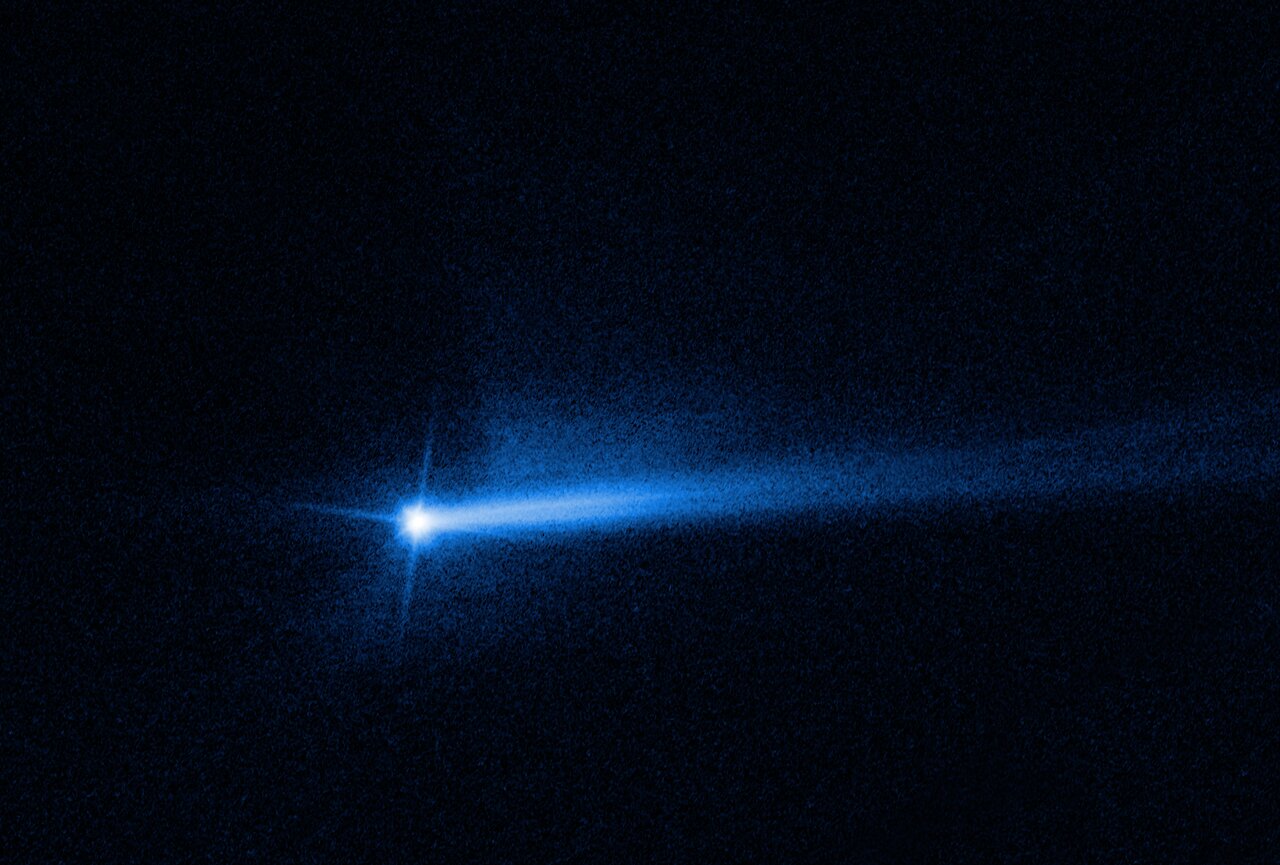
Four years after NASA deliberately crashed a spacecraft into a small asteroid, another probe has arrived to examine what the collision left behind. The European Space Agency said on 11 November that Hera had begun studying Didymos and its moonlet Dimorphos from 25 to 30 kilometres away. The survey will help researchers work out how a future deflection mission might perform against an asteroid with a different shape, mass or internal structure.
The first experiment was timed with a stopwatch, in effect. Dimorphos travels around Didymos, and observers could measure how long each orbit took before and after the impact. NASA says the collision on 26 September 2022 shortened the orbit by roughly 33 minutes. A later study identified a much smaller change in the time the pair takes to travel around the Sun. The two measurements describe different motions: one within the asteroid pair, the other around the solar system.
How Hera will get closer
ESA says Hera is using a sequence of gentle thruster firings to follow a roughly rectangular path around its targets. Each manoeuvre starts a new leg of the survey. If a firing fails, the planned geometry allows the spacecraft to drift away from the asteroids. In December, controllers plan to begin a more detailed survey on trajectories that start about 20 kilometres away. Two smaller spacecraft carried by Hera will eventually examine the system at closer range.
Images from the approach have already shown what the framing camera can see. The German Aerospace Center published views on 12 November taken from about 60 and 56 kilometres away. They showed the larger Didymos clearly, with most of Dimorphos in shadow in one frame and part of it visible in the other. The research centre said it expected to release more detailed imagery on 25 November.
Analysis — What the orbital measurement leaves open
Measuring the change in orbital period established that the collision worked. Explaining the size of that change requires knowing more about the target. Material thrown out by an impact can add to the push from the spacecraft itself. Researchers can narrow down that contribution by combining observations of the impact’s aftermath with measurements of the asteroid’s mass and the shape of its surface. A distinct crater and a more widespread reshaping would tell different stories about how the asteroid absorbed the blow.
For planetary defence, the aim is a method that can be adapted to an object scientists have had limited time to study. The value of visiting this particular moonlet again is that researchers can compare measurements of the same object with predictions made about the collision. The closer survey should help them identify which assumptions still hold when a spacecraft hits a real asteroid.